Seedance 2.5 Time-Freeze Guide: Real Examples & Prompt Tips
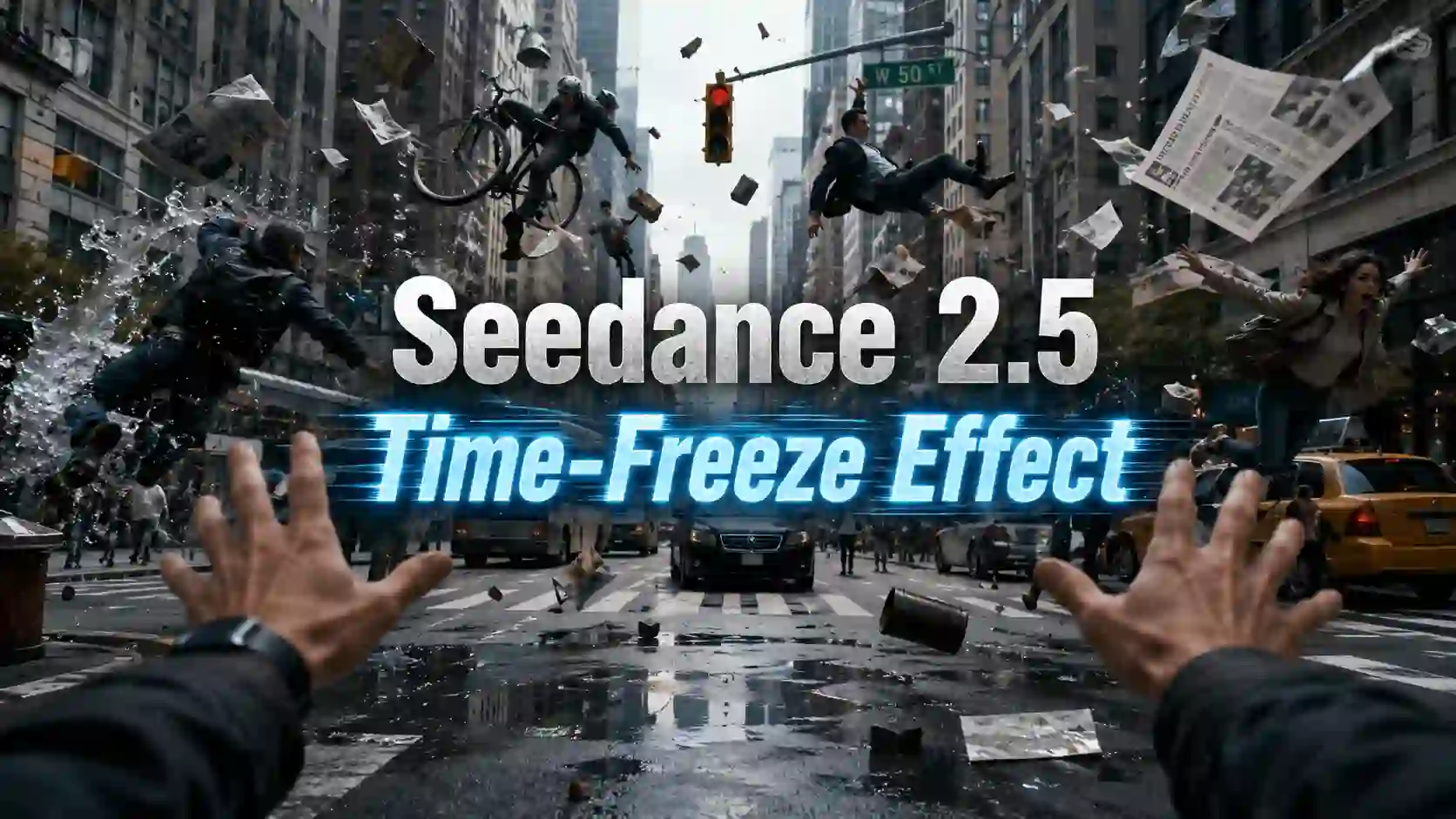
TL;DR
A cinematic time-freeze effect works only when the motion rules are clear.
Instead of writing only “freeze time,” define the motion before the freeze, the exact elements that stop, the one subject that can still move, the camera path, and the way time returns.
Show normal motion before the effect starts.
Name the people, objects, liquids, particles, and environmental details that must stop.
Define one active exception: a character, the viewer, the camera, or a product.
Keep the camera moving so the frozen environment still feels three-dimensional.
End with a clear resume, rewind, or changed outcome.
Scene → Motion → Trigger → Frozen Elements → Active Exception → Camera Path → Interaction → Resume / Rewind
Seedance 2.5 Generator Online 👉
What will You Learn?
How do you freeze people, vehicles, rain, smoke, and debris at once?
How can the camera keep moving through a frozen scene?
What makes a POV time-freeze effect feel immersive?
How can one character move while everything else stays frozen?
Why does high-speed motion make the freeze more dramatic?
How do you rewind a scene without breaking continuity?
What Makes an AI Time-Freeze Effect Different?
A freeze frame stops the image. A time-freeze scene stops the world.
In a cinematic time-freeze video, people and physical elements remain suspended while the camera or one selected subject keeps moving. That separation creates the illusion that time itself has stopped rather than the video simply pausing.
Basic: Freeze → Resume
Cinematic: Freeze → Camera explores → Resume
Interactive: Freeze → Active character moves → Interaction → Resume
Story-driven: Event → Freeze → Rewind → Intervention → New outcome
The more advanced versions use the pause to reveal, interact, or change causality—not just to create a visual trick.
Why Seedance 2.5 Fits Time-Control Scenes
Time freeze depends on motion control, continuity, and timing.
Three Seedance 2.5 capabilities are especially useful for this effect:
Longer single generations give a scene room to establish motion, freeze it, explore the result, and reach a clear ending.
Improved motion and long-form continuity help keep characters, objects, and movement relationships stable before and after the freeze.
Timestamp-based control and targeted editing make it easier to place a freeze, camera change, or correction at a specific moment.
Complex physical interactions can still fail, so the best results come from clear movement rules rather than overloaded prompts.
How to Build Better Time-Freeze Prompts
Scene + Normal Motion + Freeze Trigger + Frozen Elements + Active Exception + Camera Path + Interaction + Resume / Rewind
Step 1: Establish Motion Before the Freeze
Describe the scene while time is still running. The model needs a clear baseline before it can stop that motion.
A crowded downtown intersection during rush hour. Pedestrians cross quickly, cars move through wet streets, loose paper blows in the wind, and heavy rain falls across the scene.
Step 2: Give the Freeze a Precise Trigger
Use one obvious moment so the transition has a clear cause: a finger snap, collision, hand gesture, explosion, or device activation.
At the exact moment she snaps her fingers, time stops instantly.
Step 3: Name the Elements That Must Stop
“Everything freezes” is often too vague. List the details that are most likely to keep moving.
All pedestrians, vehicles, falling rain, hair, clothing, smoke, glass fragments, loose paper, and airborne debris remain completely motionless.
Step 4: Define the Moving Exception
State who or what is outside the freeze. Keep this rule simple.
Only the main character remains active and can move naturally through the frozen street.
Step 5: Direct the Camera Separately
Camera motion is what proves the world is frozen in three-dimensional space.
The camera slowly tracks between the frozen people, passing close to suspended raindrops and glass before circling around the main character.
Step 6: Choose One Ending
Decide whether time resumes, rewinds, or returns to a new outcome.
Time snaps back at full speed and every frozen object continues along its original trajectory.
Start with one trigger, one active subject, one camera move, and one ending.
Add more complexity only after the basic motion rule works.
Frozen City Chaos: Let the Environment and Camera Sell the Effect
Freeze the chaos, then move through it.
A busy disaster scene works because many motion layers—people, vehicles, glass, smoke, sparks, and debris—stop at once while the camera keeps moving.
Prompt
A chaotic downtown street erupts with running pedestrians, braking vehicles, shattered glass, sparks, smoke, and flying debris. At the peak of the action, time stops instantly. Every person, vehicle, glass fragment, spark, smoke trail, dust particle, and piece of debris becomes completely frozen. The camera remains active, slowly dollying through the suspended scene and weaving between floating glass and halted explosions. A bright pulse forms at the center as glowing cracks spread across the frozen environment. At the climax, time snaps back and every suspended element resumes its original motion in a sudden burst of energy.
💡 Prompting Tip
Build visible depth:
place fragments in the foreground
frozen characters in the midground
vehicles or destruction behind them
A moving camera can then reveal the freeze as a real 3D space.
❕ Avoid These Errors
Smoke continues expanding after the freeze.
Debris slowly drifts instead of locking in place.
People change pose as the camera moves.
Particles disappear between viewpoints.
The camera freezes together with the environment.
Complex environment, simple event.
Drift Freeze: Use Speed to Amplify Stillness
Extreme speed makes absolute stillness feel stronger.
A drifting car gives the model a clear contrast between fast motion and an instant stop, while rain, spray, sparks, and reflections add details that make the freeze visible.
Prompt
A high-speed sports car drifts through a neon-lit city at night. Wet asphalt reflects bright signage while heavy rain falls and sparks trail from the wheels. At the peak of the drift, time stops instantly. The car freezes sideways, the wheels lock, and every raindrop, spark, glass fragment, water spray, and nearby vehicle remains completely suspended. The camera stays active, making a low 360-degree orbit around the car, passing close to the wheels and through the frozen rain and sparks. Time suddenly resumes; the car regains traction and launches forward while water, sparks, and debris continue along their original paths.
💡 Prompting Tip
Describe the motion on both sides of the freeze.
Give the model a clear path to preserve:
acceleration → drift → freeze → traction → escape.
❕ Avoid These Errors
The car slows down instead of stopping instantly.
The wheels keep rotating.
Rain or road spray continues falling.
The car changes direction after time resumes.
The restart lacks acceleration or traction.
Freeze velocity, do not merely slow it down.
POV Freeze: Make the Viewer the Moving Exception
Make the viewer is the only thing outside time.
A first-person setup turns frozen time into a superpower. The key is to separate perspective, movement permission, and interaction.
Prompt
First-person POV on a busy city street in daylight, filmed with a wide cinematic lens. Both hands are visible while the viewer walks naturally through moving traffic and pedestrians. Suddenly, time stops. All people, vehicles, clothing, airborne objects, and debris become completely frozen. Only the viewer remains active. The camera continues moving slowly through the crowd as the viewer reaches out and gently shifts one suspended object. The frozen world remains perfectly still. After a short pause, time snaps back and every person, object, and environmental sound returns at once.
💡 Prompting Tip
Perspective: first-person POV with visible hands.
Motion rule: only the viewer moves.
Interaction: touch one specific frozen object.
❕ Avoid These Errors
Too many hand interactions in one shot.
Unexpected switches to third-person framing.
Objects sticking to the hands after contact.
Frozen characters moving during the interaction.
The camera losing the original spatial direction.
One clean interaction usually works better than several complicated ones.
Crowd Freeze: Give One Character Clear Permission to Move
A crowded frame works only when the exception is unmistakable.
Large groups create a stronger illusion, but they also make accidental movement easier to notice. Define the moving subject explicitly and keep everyone else locked.
Prompt
A cinematic 15-second scene inside a packed sports bar with realistic neon lighting and shallow depth of field. A man walks through a loud celebration while fans jump, raise drinks, and throw popcorn. He snaps his fingers and time stops instantly. Everyone except him freezes completely. Beer splashes, droplets, popcorn, clothing, dust, and jumping fans remain suspended in place. Only the man and camera keep moving. He walks beneath a frozen arc of beer, takes one popcorn kernel from the air, and casually adjusts a frozen fan’s cap. He snaps again. Time resumes immediately: the beer completes its splash, popcorn falls, fans land, and the crowd noise returns.
💡 Prompting Tip
Only the main character and the camera can move. Every background person, liquid splash, and airborne object remains completely frozen.
❕ Avoid These Errors
Background characters blink or breathe visibly.
Raised arms slowly drop.
Drinks continue spilling.
Crowd positions shift between camera moves.
A second character becomes active by accident.
The larger the crowd, the simpler the motion rule should be.
Freeze and Rewind: Turn Time Control Into a Story
Do not just pause the accident, change what happens next.
Rewind adds narrative value because the scene must restore people, objects, liquids, and spatial relationships before the protagonist changes the outcome.
Prompt
A photorealistic 1950s American diner with chrome stools, red booths, checkerboard flooring, warm practical lights, and subtle film grain. A young woman sits at the counter drinking a milkshake while a waitress carries eggs, bacon, and a full coffee pot behind her. An older customer stands and collides with the waitress. Food, the tray, and coffee fly into the air. At the peak of the collision, time freezes instantly. Everyone and every airborne object stops completely except the woman at the counter. The camera slowly orbits the frozen diner while she takes another sip. Then the accident rewinds: every person, object, and coffee droplet retraces its exact path until the scene returns to the moment before the collision. The woman gestures to the waitress, who turns and avoids the accident. End on a close-up of the woman taking one final calm sip.
💡 Prompting Tip
Define three stages:
what reverses → where it returns → what changes afterward.
Use:
Accident → Freeze → Rewind → Intervention → New Outcome.
❕ Avoid These Errors
Adding a second storyline during the rewind.
Liquid returning to the wrong container or position.
Characters changing identity during reverse motion.
Objects returning along a new path instead of the original trajectory.
The scene layout changing after the rewind.
One event. One rewind. One changed outcome.
How to Keep a Time-Freeze AI Video Believable
The illusion usually breaks in the smallest movements.
A generation can look impressive overall and still feel obviously AI-generated because one subtle element continues moving.
Review the details before judging the whole shot.
Faces: No blinking, drifting expressions, or head movement.
Bodies: No posture changes or visible breathing.
Hair and clothing: No residual wind or fabric movement.
Liquids: Splash shapes remain suspended with stable volume.
Particles: Rain, dust, smoke, sparks, and debris do not drift or disappear.
Vehicles: Wheels and body position stay locked.
Camera: Movement stays smooth and independent from the freeze.
Release: Motion resumes from the same direction and physical state.
Better physical consistency reduces the “AI-generated” feel, which is especially useful for UGC concepts, cinematic demos, product advertising, action previs, and other realism-driven videos.
Where Time-Freeze Effects Work Best
A visual trick becomes useful when it directs attention.
Use Case | Creative Direction |
TikTok / Reels | Freeze the busiest moment to create a strong opening hook. |
UGC ads | Pause the problem before revealing the solution. |
Product ads | Freeze the environment while the product remains active. |
Fashion | Let the model or camera move through a frozen crowd. |
Music videos | Keep the performer moving while dancers stop. |
Game cinematics | Pause combat just before a decisive hit. |
Film demos | Explore an accident or action beat in suspended time. |
Superhero videos | Use POV time control as a first-person power. |
Short films | Rewind a mistake and create a new outcome. |
For commercial work, one of the simplest formulas is:
Freeze everything except the product.
That immediately creates a visual hierarchy and tells viewers where to look.
How to Fix Common Time-Freeze Problems
1. Frozen people still move
✅ Fix: Add explicit constraints for eyes, expressions, body position, hair, and clothing.
2. The effect looks like slow motion
✅ Fix: Use direct wording such as “time stops instantly” and “all motion becomes completely frozen.”
3. The camera stops too
✅ Fix: State that the environment freezes while the camera continues moving smoothly.
4. Liquids, smoke, or debris keep moving
✅ Fix: Name each visible element and require it to remain fixed at the exact freeze position.
5. The wrong character moves
✅ Fix: Define one active exception and state that every other person remains frozen.
6. Props disappear or shift
✅ Fix: Name important objects and require the same position, shape, and spatial relationship throughout the freeze.
7. The release feels like a new shot
✅ Fix: Tell the model to continue the original motion and trajectory when time resumes.
8. The rewind does not restore the scene
✅ Fix: Require people, objects, liquids, and particles to retrace their exact original paths.
9. The scene has too many interactions
✅ Fix: Reduce the first attempt to one active subject, one interaction, one camera move, and one ending.
If the effect fails, simplify the movement rules before adding more descriptive detail.
Build Your Own Time-Control Scene
Keep the rule simple, then push the idea further.
A viral time-freeze clip is only a starting point. Change the location, trigger, active subject, camera path, interaction, or ending to create something that fits your own story or campaign.
Turn a frozen car chase into a product launch.
Turn a frozen crowd into a fashion film.
Turn a rewind into a comedy, thriller, or short narrative.
Start with one clear Seedance 2.5 time-freeze prompt, generate the scene, review which motion rule worked, and improve one variable at a time. The goal is not to copy a viral effect—it is to control time in a way that serves your own idea.
Create Time-Freeze with Seedance 2.5 👉
Seedance 2.5 Time-Freeze FAQs
Should I Use Text-to-Video or Image-to-Video for a Time-Freeze Scene?
Use text-to-video when the scene can be flexible. Use image references when a specific character, vehicle, product, outfit, or composition must stay recognizable.
Can I Make a Vertical 9:16 Time-Freeze Video?
Yes. A vertical composition works well for TikTok, Reels, and Shorts. Keep the main moving subject near the center and avoid placing critical frozen details too close to the frame edges.
What Should Happen to Audio When Time Stops?
Use contrast: full ambience before the freeze, near-silence during it, and an immediate return of environmental sound when time resumes. A snap, bass hit, or short impact cue can make the transition clearer.
Do I Need a Full 30 Seconds for the Effect?
No. Short clips work well for a simple freeze-and-resume hook. Use longer duration when the effect includes setup, interaction, rewind, or a changed outcome.
Can I Repair One Bad Moment Without Rebuilding the Whole Scene?
When targeted editing is available, focus the correction on the failed timestamp or action. This is especially useful when the freeze works but one interaction, camera move, or release moment does not.
Why Does the Same Prompt Produce Different Time-Freeze Results?
AI video remains probabilistic. Treat the prompt as a production blueprint rather than a guaranteed render, and improve one variable at a time instead of rewriting everything after each attempt.
Related Articles
Seedance 2.5 for Business: Industrial AI Video Workflows
Explore Seedance 2.5 for business, from industrial AI video and SOP training to product demos, game previs, ads, robotics, and synthetic data.
Seedance 2.5 vs Seedance 2.0: Real Tests Comparison
Compare Seedance 2.5 and Seedance 2.0 through real video tests covering storytelling, creative understanding, action physics, product ads, UGC, and cost.